
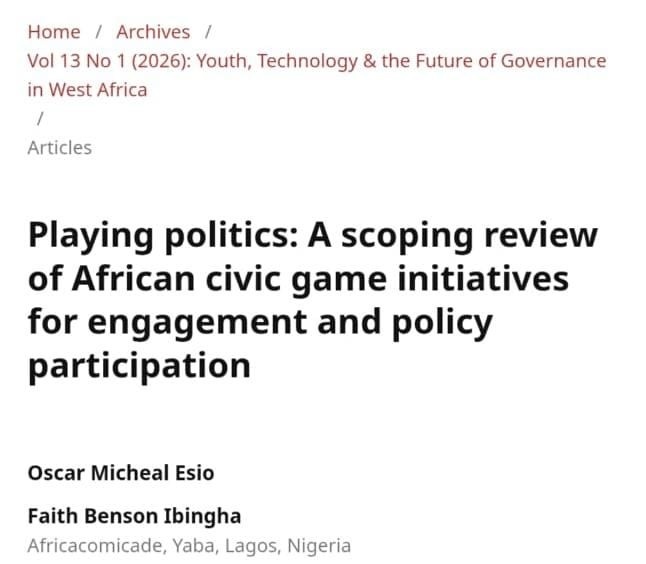
On July,2026 , the Nigerian Journal of Business and Social Sciences published our paper tagged “Playing Politics : A scoping review of African Civic game initiatives for engagement and policy participation”. Games for change has always struggled with one question: how do you know a game is actually changing anything? The Play-to-Impact Framework, developed by Oscar Michael Esio, founder of Africacomicade, offers an answer.
First presented at the Games and SDG Summit at the United Nations Office in Nairobi on 22 April 2026, it’s a practical, four-layer framework for designing serious games that create measurable, sustainable real-world impact in education, health, climate, governance, and beyond.
It draws on established theory of change models, game mechanics mapping, and behavioural frameworks like COM-B and RE-AIM, translating them into something studios and funders can actually use.
What is a Serious Game?
A serious game isn’t an information campaign with points bolted on. It’s a game intentionally designed to drive a non-entertainment outcome , knowledge, skills, attitude shifts, behaviour change, wellbeing, participation, or wider institutional impact , while still functioning as a genuinely engaging game. The desired thinking or behaviour has to become part of what the player repeatedly does, not just something they’re told.
Four Structural Gaps in the Games for Change Ecosystem
Before offering solutions, the framework acknowledges there are four structural failures in the current games ecosystem
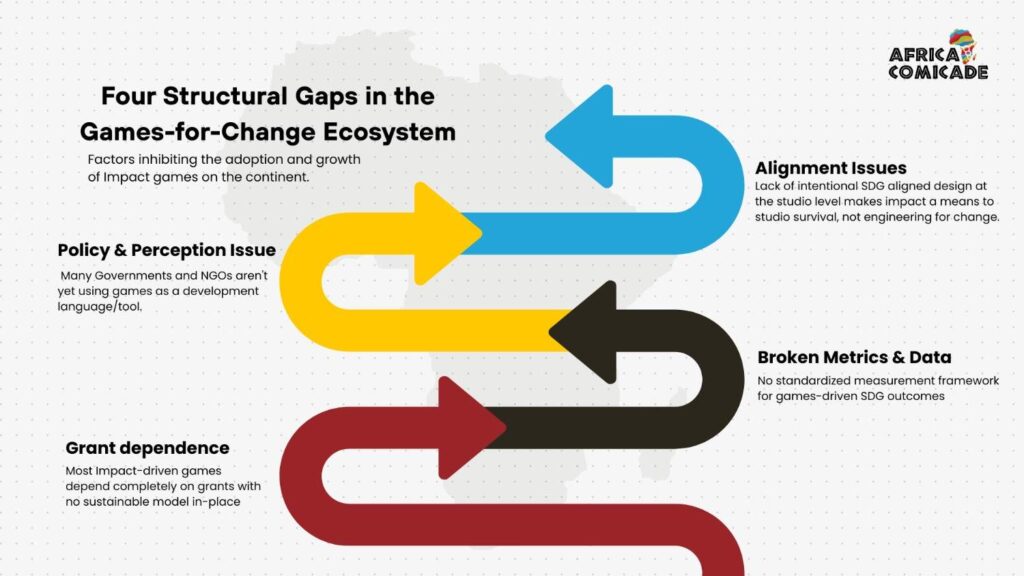
- Funding: Most impact games run entirely on grants. When the grant ends, so does the game.
- Data: There’s no standardized way to measure games-driven SDG outcomes. Impact claims lean on download counts and anecdotes instead of real behavioural evidence.
- Policy: Many governments and NGOs still don’t treat games as a legitimate development tool, limiting commissioning and integration into formal systems.
- Alignment: Without intentional design at the studio level, impact becomes a funding narrative rather than an actual design discipline.
The Play to Impact framework
The framework tests every game against four connected layers. One core rule: no single layer can compensate for a weak one : a brilliant game with no reach has limited impact, and wide distribution without strong design only proves exposure, not change.
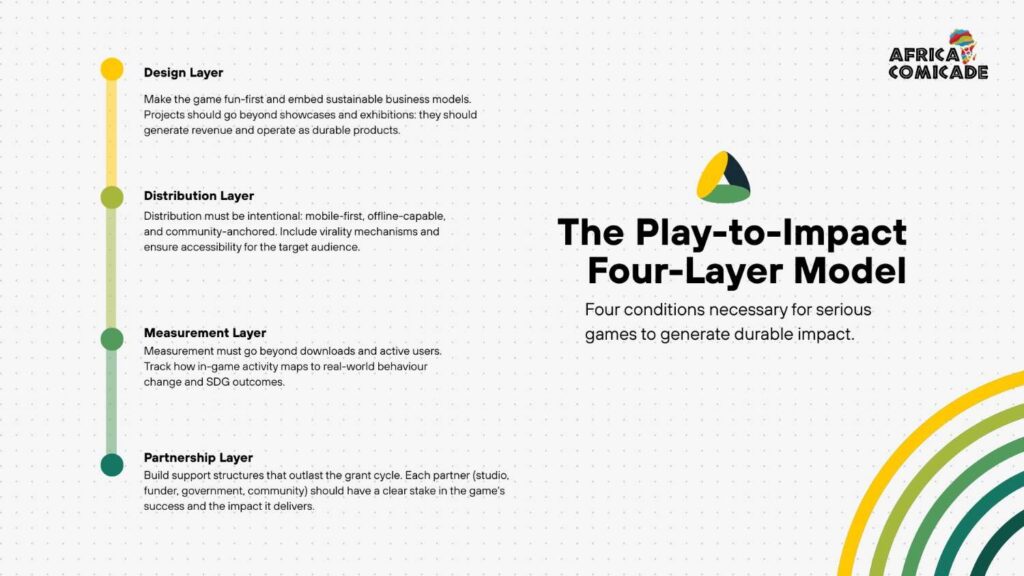
Design Layer — Build fun-first, always. Drawing on the Extended Elaboration Likelihood Model (Moyer-Guse, 2008), behaviour change sticks best when it’s embedded in genuinely engaging gameplay, not illustrated information. The game also needs a real business model — designed to generate revenue and survive beyond the grant cycle, not exist as a one-off showcase.
Distribution Layer — Be intentional: mobile-first, offline-capable, and community-anchored, recognizing that connectivity is uneven across the continent. Partner with schools, institutions, and local networks to reach the right audiences, and build virality into the design from day one.
Measurement Layer — Go beyond downloads and active users. Track how in-game activity maps to real-world behaviour change, using pre- and post-testing, COM-B to diagnose player behaviour, co.LAB to design mechanics, and RE-AIM to evaluate real-world outcomes.
Partnership Layer — Build support structures that outlast any single grant cycle. Every partner — studio, funder, government, community — needs a genuine stake in the game’s success, reducing dependence on any one funding stream.
no single layer can compensate for a weak one : a brilliant game with no reach has limited impact, and wide distribution without strong design only proves exposure, not change.
A Call to Action
- Funders and policymakers: Engage directly with the game development ecosystem. Learn how it works before trying to commission from it.
- Studio founders: Treat game development as a business. Build the systems and structures the opportunities you want actually require, and design for impact from day one — not as an afterthought.
- Summit and convening organizers: Make serious games spaces more accessible to studios outside Lagos, Nairobi, and Cape Town.
The Play-to-Impact framework is a call for the African games for change and social impact space to grow up from good intentions into credible, sustainable, evidence-backed interventions.
You can access the paper on the Nigerian Journal of Business and Social Sciences website.
This framework was delivered as a major outcome form the research done uner our Evolve Africa Challenge initiative, where we promote social entreprenuership in the African Video games, Animation, Comics and XR industry.